CLAT 2027: Exam Date, Preparation, Online Coaching (All Info)
Limited Slots!
CLAT 2027 Online Coaching
CLAT 2027 Target Course
Designed for Class 12 students preparing for the CLAT 2027 exam. Ideal for aspirants seeking structured daily preparation alongside school studies.
- 800+ Hours Live Classes
- 5 Days / Week Classes
- 80 Mock Tests
CLAT 2027 Finisher Course
A focused program for droppers and repeaters targeting CLAT 2027 who want disciplined preparation and consistent practice.
- 800+ Hours Live Classes
- 5 Days / Week Classes
- 80 Mock Tests
CLAT 2027 Comeback Course
Designed for partial droppers preparing for CLAT 2027 while attending regular college. Two-phase preparation balances academics and CLAT preparation.
- Two-Phase Prep Plan
- Concept + Practice Focus
- National Mock Tests
CLAT 2027 Weekend Classes
- Weekend Live Classes
- Structured Study Plan
- Mentor Guidance
CLAT 2027 English Medium Batch
- 100% English Interaction
- 800+ Hours Live Classes
- Structured Preparation
CLAT 2027 Recorded Course
- 700+ Recorded Classes
- 35 Full-Length Mock Tests
- 40 CLAT Preparation Books
What is CLAT 2027?
CLAT 2027 is the Common Law Admission Test conducted for admission to undergraduate law programs offered by National Law Universities (NLUs) and several other participating law colleges in India. The exam is organized by the Consortium of NLUs and serves as the primary gateway for students who want to pursue a five-year integrated law degree such as BA LL.B (Hons), BBA LL.B (Hons), B.Com LL.B (Hons), and other similar programs.
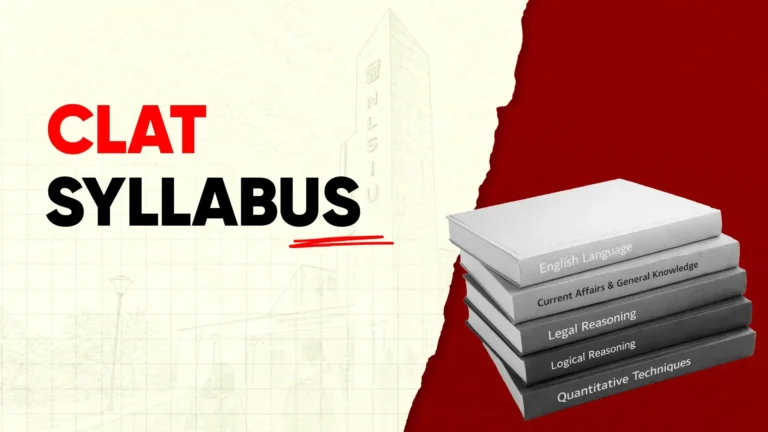
Through CLAT 2027, students compete for admission to 26 National Law Universities across India, along with many other law schools that accept CLAT scores. The exam evaluates candidates through comprehension-based questions covering English, Current Affairs, Legal Reasoning, Logical Reasoning, and Quantitative Techniques.
CLAT 2027 is meant for Class 12 students planning to enter law school after school, as well as droppers, repeaters, and partial droppers who want to reattempt the exam for a better rank. A strong score in CLAT 2027 opens opportunities to study law at some of the most reputed institutions in the country.
CLAT 2027 Exam Date
The CLAT 2027 exam date is expected to be 6 December 2026, following the pattern of the exam being held on the first Sunday of December.
Students preparing for CLAT 2027 should track all important dates related to notification, registration, admit card, exam, and results. The expected timeline below helps aspirants plan their preparation and application process well in advance.
Event | Expected Date |
CLAT 2027 Notification | July 2026 |
Registration Start Date | 1 August 2026 |
Last Date to Apply | October 2026 |
Application Correction Window | October 2026 |
Admit Card Release | November 2026 |
CLAT 2027 Exam Date | 6 December 2026 |
Provisional Answer Key | 7-9 December 2026 |
Final Answer Key | 15-16 December 2026 |
CLAT 2027 Result | 15-16 December 2026 |
Counselling Process | 20-25 December 2027 |
CLAT 2027: Exam Pattern
Understanding the CLAT 2027 exam pattern helps aspirants know the structure of the test and prepare according to the marking scheme and sections.
Feature | Details |
Exam Name | CLAT 2027 |
Exam Mode | Offline (Pen and Paper) |
Duration | 2 Hours |
Total Questions | 120 |
Total Marks | 120 |
Question Type | Multiple Choice Questions |
Marking Scheme | +1 for Correct Answer |
Negative Marking | -0.25 for Wrong Answer |
Sections | English, Current Affairs & GK, Legal Reasoning, Logical Reasoning, Quantitative Techniques |
CLAT 2027: Subjects / Sections
The CLAT 2027 exam is divided into five sections designed to test a student’s reading comprehension, reasoning ability, awareness of current affairs, and basic numerical skills. Each section contains passage-based questions where students must read carefully, analyze information, and answer multiple-choice questions within a limited time.
Understanding the CLAT 2027 subjects and their weightage helps aspirants plan their preparation effectively and focus more on sections that carry higher marks.
Section | Number of Questions | Approximate Weightage |
English Language | 22–26 questions | Around 20% |
Current Affairs, including General Knowledge | 28–32 questions | Around 25% |
Legal Reasoning | 28–32 questions | Around 25% |
Logical Reasoning | 22–26 questions | Around 20% |
Quantitative Techniques | 10–14 questions | Around 10% |
CLAT 2027: Eligibility Criteria
Students planning to appear for CLAT 2027 must meet the academic requirements set by the Consortium of National Law Universities.
Eligibility Requirement | Details |
Educational Qualification | Candidates must have passed or be appearing in Class 12 or equivalent examination |
Minimum Marks | 45% marks for General/OBC/PWD/NRI candidates |
Reserved Category Marks | 40% marks for SC/ST candidates |
Age Limit | No upper age limit for CLAT UG |
Appearing Candidates | Students appearing for Class 12 in 2026 are also eligible to apply |
CLAT 2027: Marking Scheme
Knowing the CLAT 2027 marking scheme helps aspirants plan their attempt strategy and manage accuracy during the exam.
Marking Feature | Details |
Marks for Correct Answer | +1 Mark |
Negative Marking | -0.25 Marks |
Marks for Unattempted Question | 0 Marks |
Question Type | Multiple Choice Questions |
Total Marks | 120 Marks |
CLAT 2027 Exam: Syllabus
The CLAT 2027 syllabus focuses mainly on comprehension-based questions where students must read passages, understand arguments, and answer analytical questions. The exam tests reading ability, reasoning skills, awareness of current affairs, and basic numerical interpretation rather than rote memorization. Understanding the syllabus helps aspirants prepare in a structured and focused manner.
English Language Syllabus
The English section in CLAT 2027 tests reading comprehension, vocabulary, and language interpretation through passages of around 450 words.
Key Topics:
- Reading comprehension passages
- Understanding the main idea of a passage
- Drawing inferences and conclusions
- Identifying arguments and viewpoints
- Summarizing passages
- Word meanings in context
- Vocabulary usage
- Comparing arguments and viewpoints
Current Affairs & General Knowledge Syllabus
This section evaluates awareness of recent events and their background context. Questions are usually passage-based and require understanding of important developments.
Key Topics:
- National and international current affairs
- Government policies and initiatives
- Important legal developments
- International organizations and events
- Economy and business news
- Science and technology developments
- Awards and honours
- Important historical events related to current affairs
Legal Reasoning Syllabus
Legal reasoning is one of the most important sections in CLAT 2027. Students are tested on their ability to understand legal principles and apply them to situations.
Key Topics:
- Legal principles and legal propositions
- Application of legal rules to fact situations
- Legal passages and reasoning questions
- Contemporary legal issues
- Public policy discussions
- Legal awareness through passages
- Understanding legal arguments and conclusions
Logical Reasoning Syllabus
The logical reasoning section evaluates analytical thinking and reasoning ability through passage-based questions.
Key Topics:
- Identifying arguments and assumptions
- Drawing logical conclusions
- Strengthening or weakening arguments
- Recognizing patterns of reasoning
- Analysing logical relationships
- Identifying inconsistencies in arguments
- Logical inference questions
Quantitative Techniques Syllabus
This section evaluates numerical ability through short passages containing graphs, tables, or numerical information.
Key Topics:
- Basic arithmetic concepts
- Ratios and proportions
- Percentages
- Averages
- Profit and loss
- Simple interest
- Interpretation of graphs and charts
- Data interpretation problems
CLAT 2027: Registration
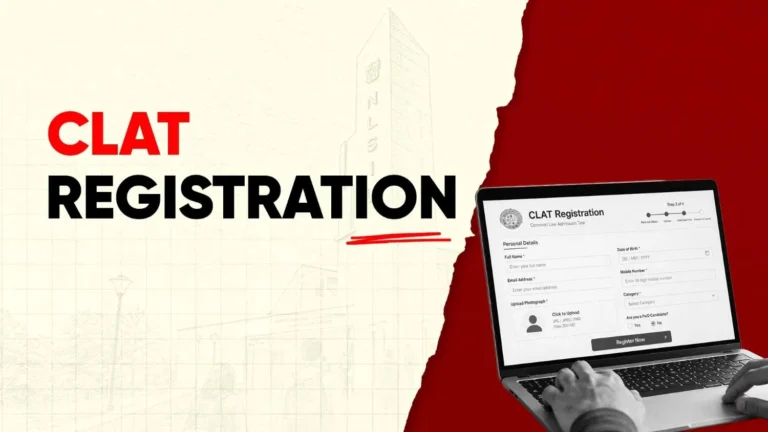
The CLAT 2027 registration process will begin once the application window opens on 1 August 2026 and will remain available until 31 October 2026. Candidates must complete the online application within this period through the official CLAT portal.
Step 1 – Visit the CLAT Application Portal
Visit the official CLAT website once the application window opens. Start registration by creating your login credentials.
Step 2 – Create Your Account
Register using your name, mobile number, and email address. After verification, you will receive login details to access the application form.
Step 3 – Fill the CLAT 2027 Application Form
Enter personal details, academic qualifications, category information, and exam preferences carefully while filling the CLAT 2027 application form.
Step 4 – Upload Required Documents
Upload scanned copies of your photograph, signature, and required certificates as specified in the application instructions.
Step 5 – Select NLU Preferences
Choose your preferred National Law Universities in order of priority. These preferences are important for seat allotment during counselling.
Step 6 – Pay the Application Fee
Complete the application process by paying the CLAT registration fee online and download the confirmation page for future reference.
CLAT 2027: Admit Card
The CLAT 2027 admit card is a mandatory document that candidates must carry to the examination center. It contains important information such as the exam center details, reporting time, and candidate information required for verification on the exam day.
Students should download the admit card from the official CLAT portal once it is released.
Feature | Details |
Admit Card Release | Expected in November 2026 |
Where to Download | Official CLAT website |
Login Required | Registered Email ID and Password |
Mandatory for Exam | Yes |
Details Mentioned on the Admit Card
- Candidate’s name
- Roll number
- Photograph and signature
- Exam date and reporting time
- Examination center details
- Important exam instructions
CLAT 2027: Exam Day Instructions
Candidates appearing for CLAT 2027 should carefully follow the exam day instructions to avoid any issues at the examination center.
- Carry a printed copy of the CLAT 2027 admit card.
- Bring a valid government-issued photo ID for verification.
- Reach the examination center before the reporting time mentioned on the admit card.
- Follow the seating arrangement provided by the exam authorities.
- Use only the permitted stationery items during the exam.
- Electronic devices such as mobile phones, smart watches, and calculators are not allowed.
CLAT 2027 Preparation Strategy
Start with a Clear Study Plan
Begin your CLAT 2027 preparation with a structured study plan that covers all five sections of the exam. Divide your week between concept learning, reading practice, mock tests, and revision. A clear schedule helps you stay consistent and prevents last-minute pressure as the exam approaches.
Build a Strong Daily Reading Habit
CLAT is a comprehension-based exam, so your reading ability plays a major role in your score. Read newspapers, editorials, and analytical articles daily. Focus on understanding arguments, viewpoints, and context rather than simply reading quickly. This habit will improve performance in English, Current Affairs, Legal Reasoning, and Logical Reasoning sections.
Focus on Concept Clarity Before Practice
Before attempting large numbers of questions, ensure that you understand the concepts behind each section. For example, understand how legal principles work in Legal Reasoning or how arguments are structured in Logical Reasoning. Strong conceptual understanding allows you to solve unfamiliar questions confidently during the exam.
Practice Section-Wise Questions Regularly
After learning concepts, start solving section-wise practice questions. This helps you gradually improve accuracy and understand the types of questions asked in CLAT. Focus on solving questions from different passages and topics so that you develop versatility in your problem-solving approach.
Attempt Full-Length Mock Tests Consistently
Mock tests are the closest experience to the actual CLAT exam. Start with occasional mocks early in your preparation and increase frequency as the exam approaches. Mock tests help you improve speed, manage time across sections, and build the confidence needed to perform well on exam day.
Analyze Every Mock Test Carefully
Many students attempt mock tests but skip the analysis stage. After every test, carefully review incorrect answers, understand why mistakes occurred, and note the areas that require improvement. This process is one of the most effective ways to improve your performance over time.
Maintain Consistency and Regular Revision
Consistency is the most important factor in CLAT preparation. Study daily, revise important concepts regularly, and keep practicing questions throughout the year. Small, consistent improvements in reading, reasoning, and mock test performance can significantly improve your final CLAT rank.
Mistakes to Avoid in CLAT 2027 Preparation
Many aspirants work hard for CLAT but still make avoidable mistakes that slow down their progress. Being aware of these mistakes can help you prepare more effectively.
- Starting preparation without a proper study plan
- Ignoring daily reading and current affairs preparation
- Focusing only on theory instead of practicing questions
- Attempting mock tests but not analyzing performance
- Collecting too many study materials and getting confused
- Neglecting weaker sections while focusing only on strengths
- Studying irregularly instead of following a consistent routine
- Avoiding revision during the later stages of preparation
- Not managing time properly during mock tests
- Losing confidence after a few low mock scores
CLAT 2027: Study Resources
Preparing for CLAT 2027 becomes much easier when you use the right study resources and follow a structured preparation approach. Below are some important CLAT 2027 study resources that aspirants should use during their preparation.
CLAT Preparation Books
Good preparation books help you understand the concepts and practice different types of questions asked in CLAT. Books for English comprehension, logical reasoning, legal reasoning, and quantitative aptitude should be part of your study routine.
CLAT Mock Tests
Mock tests are one of the most important resources for CLAT preparation. Full-length mocks help you practice under exam conditions, improve time management, and evaluate your preparation level through performance analysis.
Topic-Wise and Section-Wise Practice Tests
Regular practice tests for individual topics and sections help strengthen your understanding of concepts. They allow you to focus on weaker areas and gradually improve accuracy in different sections of the CLAT exam.
Current Affairs Resources
Current affairs is a major part of the CLAT paper. Reading newspapers, monthly current affairs magazines, and revision notes helps you stay updated with important national and international developments.
Previous Year CLAT Papers
Solving previous year CLAT papers helps you understand the exam pattern, question style, and difficulty level. It also helps you become familiar with the type of passages and reasoning questions that appear in the exam.
Structured Online Learning Resources
Students preparing through CLAT 2027 online coaching get access to live classes, recorded lectures, mock tests, performance analytics, and mentorship support. These structured resources help aspirants prepare consistently and track their progress throughout the preparation journey.
CLAT 2027 Preparation Books
Choosing the right books helps you build concepts, practice questions, and strengthen your preparation for CLAT 2027. Since the exam is comprehension-based, aspirants should focus on books that improve reading ability, reasoning skills, and legal aptitude. The following books are used by students preparing for CLAT.
Section | Recommended Books | Purpose |
English Language | Word Power Made Easy – Norman Lewis | Improve vocabulary and understanding of word usage |
English Language | High School English Grammar & Composition – Wren & Martin | Strengthen grammar and language fundamentals |
Current Affairs & GK | Manorama Yearbook | Build general awareness and important GK topics |
Current Affairs | Monthly Current Affairs Magazines | Stay updated with national and international events |
Legal Reasoning | Universal’s Guide to CLAT & LLB Entrance | Practice legal reasoning questions and concepts |
Legal Reasoning | Legal Awareness and Legal Reasoning – A.P. Bhardwaj | Understand legal principles and reasoning-based questions |
Logical Reasoning | Analytical Reasoning – M.K. Pandey | Develop logical thinking and reasoning ability |
Quantitative Techniques | Quantitative Aptitude – R.S. Aggarwal | Practice arithmetic and numerical reasoning questions |
Quantitative Techniques | Fast Track Objective Arithmetic – Rajesh Verma | Improve calculation speed and problem-solving skills |
CLAT 2027 Sectional Tests
Sectional tests play an important role in preparing for CLAT 2027 because they allow aspirants to practice one section of the exam at a time. This helps students strengthen specific sections and gradually improve their overall performance.
CLAT 2027: Study Plan
A clear and disciplined CLAT 2027 study plan helps aspirants cover the entire syllabus, build strong reading habits, and improve performance through regular practice. Since CLAT is a comprehension-based exam, preparation should combine concept learning, daily reading, mock tests, and revision.
The study plan should be structured in a way that allows you to gradually improve your understanding of each section while maintaining consistency throughout the preparation period.
Step 1 – Start with Concept Building
Begin your preparation by understanding the basic concepts of each section such as English comprehension, Legal Reasoning, Logical Reasoning, Current Affairs, and Quantitative Techniques. Focus on learning how questions are framed and how passages should be approached.
Step 2 – Develop a Daily Reading Routine
Daily reading is one of the most important parts of CLAT preparation. Read newspapers, editorials, and analytical articles every day to improve comprehension, vocabulary, and awareness of current affairs.
Step 3 – Practice Topic-Wise Questions
After understanding concepts, start practicing topic-wise questions for each section. This helps strengthen fundamentals and gradually improves accuracy in solving questions.
Step 4 – Attempt Sectional Tests
Once you are comfortable with concepts and practice questions, begin attempting sectional tests. These tests help you evaluate your performance in individual sections and identify areas that need improvement.
Step 5 – Start Full-Length Mock Tests
Full-length mock tests simulate the actual CLAT exam environment. Attempt mocks regularly to improve speed, time management, and exam confidence.
Step 6 – Analyze Performance and Improve
After every mock test, analyze your performance carefully. Identify mistakes, understand why they occurred, and work on improving those areas through targeted practice.
Step 7 – Revise and Maintain Consistency
Revision should be a regular part of your study routine. Revisit important concepts, practice difficult questions again, and continue reading daily to maintain consistency in preparation for CLAT 2027.
Why Prepare for CLAT 2027 with Online CLAT Coaching?
Learn from Experienced CLAT Mentors
Through CLAT 2027 online coaching, you learn from mentors who understand the exam pattern, question trends, and preparation strategy. Their guidance helps you build concepts, avoid common mistakes, and prepare with a focused approach.
Structured Preparation Plan
Online programs provide a clear study schedule covering all sections of the CLAT syllabus. This structure helps you manage classes, practice, revision, and mock tests in an organized manner.
Access from Anywhere in India
With online CLAT coaching, you can prepare from any city without relocating. Students from different parts of India receive the same expert guidance and resources.
National-Level Mock Test Practice
Online coaching platforms conduct national-level mock tests where you compete with aspirants across the country. This helps you understand the actual competition level and improve your exam performance.
Flexible Learning Environment
Recorded classes and online study material allow you to revise concepts whenever required. This flexibility helps you manage school or college studies while preparing consistently for CLAT.
Continuous Performance Tracking
Online learning platforms provide detailed performance reports after tests. These analytics help you understand your strengths, identify weak areas, and improve your preparation gradually.
Mentorship and Doubt Support
Mentors regularly guide students on preparation strategies, study plans, and mock analysis. Continuous doubt-solving support ensures that you stay clear about concepts throughout preparation.
Key Features of CLAT 2027 Online Coaching
Live Interactive Classes
Students attend live online classes where mentors explain concepts, solve practice questions, and discuss strategies to help aspirants understand the CLAT syllabus effectively.
Recorded Lectures for Revision
All live sessions are recorded so students can revisit important lectures anytime. These recordings help revise difficult topics and ensure no concept is missed during preparation.
Comprehensive Study Material
Students receive structured study material designed according to the CLAT exam pattern. These resources help aspirants practice questions and strengthen their understanding of different sections.
National-Level Mock Tests
Regular mock tests simulate the real CLAT exam environment. These tests help students improve time management, develop exam temperament, and track their performance.
Topic-Wise Practice Tests
Topic-wise tests allow students to practice questions immediately after learning concepts. This approach helps strengthen understanding and gradually improve accuracy in solving questions.
Section-Wise Practice Tests
Sectional tests focus on individual areas such as English, Legal Reasoning, Logical Reasoning, Current Affairs, and Quantitative Techniques to improve performance across all sections.
Detailed Performance Reports
After each test, students receive performance analytics showing accuracy, time usage, and section-wise scores. These insights help aspirants understand where improvement is needed.
Doubt-Solving Sessions
Dedicated doubt sessions allow students to ask questions related to concepts, practice tests, or mock analysis. These sessions ensure students stay clear about important topics.
Mentorship Guidance
Students receive mentorship support that helps them stay disciplined and focused during preparation. Mentors guide them on study plans, exam strategies, and improvement areas.
Current Affairs Resources
Students receive curated current affairs resources including monthly magazines and revision notes that help them stay updated with important events relevant for CLAT.