CLAT Previous Year Question Papers PDF (2008-2026)

Download CLAT Previous Year Question Papers PDF (2008–2026) with solutions. Practice real exam papers and boost your preparation for better scores.
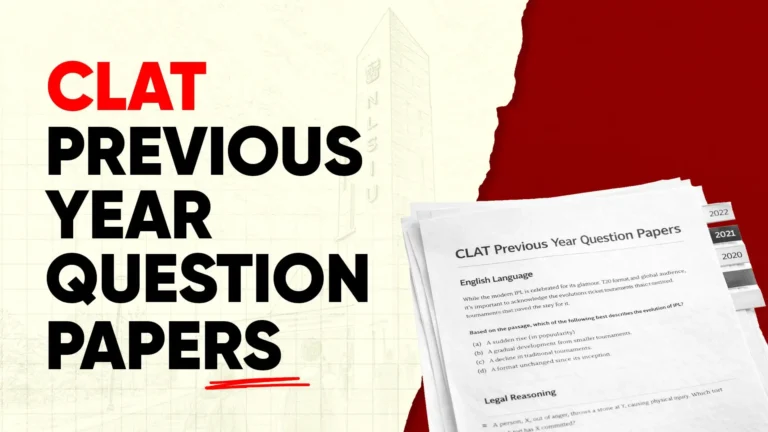
CLAT Previous Question Paper sets help you move from basic preparation to exam-focused practice. As competition increases each year, a clear idea of the actual paper becomes important. CLAT Previous Question Paper sets show how questions appear in the exam conducted by the Consortium of  National Law Universities (NLUs).

Many students face difficulty while searching for complete and reliable papers. A year-wise collection of CLAT Previous Question Paper PDFs saves time and keeps your preparation organised. Instead of switching between multiple sources, you can focus directly on solving papers and analysing performance.

Regular practice with CLAT Previous Question Paper sets improves understanding of passage structure and question patterns across sections. You begin to see how English, Legal Reasoning, and Current Affairs are balanced in the paper. With consistent practice, accuracy improves, and you develop better control over time during the exam.

CLAT Previous Year Question Paper Highlights

CLAT Previous Question Paper analysis gives you a clear starting point for preparation. Many students begin studying without knowing how the exam actually feels, which creates confusion later. CLAT Previous Question Paper sets help you understand the structure, difficulty level, and type of questions asked in recent years.

CLAT 2022 followed the older format with 150 questions in 120 minutes. From CLAT 2023 onwards, the pattern shifted to 120 questions in 120 minutes. The same format has continued in CLAT 2024, 2025, and 2026, which shows a stable and predictable exam structure.

A quick overview of the current exam pattern helps you plan your preparation more effectively:

Parameters of CLAT Question PaperDetails of the Parameters
Total Questions120 (Multiple Choice Questions – MCQs)
Total Marks120
Duration of CLAT exam120 minutes (2 hours)
Marking Scheme+1 for each correct answer-0.25 for each incorrect answer0 for unattempted questions
Mode of ExamOffline (pen-and-paper, OMR-based)
MediumEnglish only
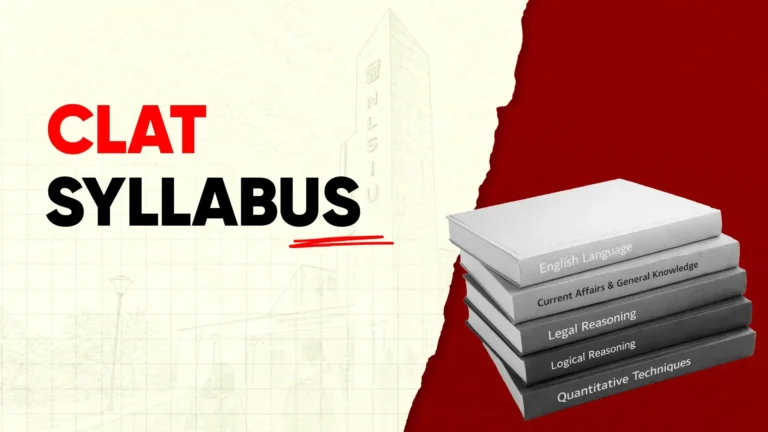
Sections of CLAT exams1. English Language2. Current Affairs including General Knowledge3. Legal Reasoning4. Logical Reasoning5. Quantitative Techniques
Questions & Weightage– English Language:
22-26 Questions (~20%)
– Current Affairs including General Knowledge: 28-32 Questions (~25%)
– Legal Reasoning: 28-32 Questions (~25%)
– Logical Reasoning: 22-26 Questions (~20%)
– Quantitative Techniques: 10-14 Questions (~10%)
Total: 120 questions (100%)

Start your CLAT preparation with expert-led Online CLAT Coaching today.

CLAT Exam Pattern Overview

A reduced number of questions with the same duration changes the way you attempt the paper. The focus shifts towards reading speed, clear understanding, and accurate decision-making under time pressure. A higher number of attempts does not guarantee a better score, so accuracy and time management become more important.

A year-wise view of CLAT Previous Question Paper trends helps you understand how the exam has evolved and what to expect during preparation.

CLAT Previous Year Question PaperOverall DifficultyImportant Highlights & TrendsAverage Good Attempts 
2022Moderate to Difficult– Last paper with 150 questions; – Very lengthy with high reading load; – Strong time pressure100-110 (out of 150)
2023High (Toughest)– Significant drop in scores; – Complex passages and unpredictable patternLower than usual
2024Moderate– Introduction of 120-question format; – More structured and balanced paper90-105 (out of 120)
2025Easy to Moderate– Student-friendly paper; – Shorter and clearer passages; – Higher scoring potential100-110+ (out of 120)
2026Moderate– Balanced paper with slight surprises; – Stronger focus on analytical reading84-99 

Year-Wise CLAT Previous Year Question Paper Analysis

Grab Your CLAT Notes Before the Exam Rush!

Previous Year CLAT Question Paper 2021 to 2026

Previous Year CLAT Question Paper 2021 to 2026

After reviewing the highlights and understanding how the exam pattern and difficulty have changed in recent years, the next step is to start practising with actual papers. CLAT previous year question papers from 2021 to 2026 follow the latest format, so they give you a clear and practical idea of how the exam is structured today.

At this stage, you should focus on applying what you have understood from the analysis above. Solving these papers in a timed setting helps you experience the real exam environment. You begin to see how passages are structured, how questions are connected, and how time needs to be managed across sections.

A useful approach is to attempt one paper in 120 minutes without breaks, and then analyse your performance. Check where you lost marks, which sections took more time, and where accuracy needs improvement. Regular practice in this way will help you build confidence and improve consistency.

Below, you can download the year-wise CLAT previous year question papers:

CLAT Previous Year Question PaperDownload Link for Question Paper
CLAT Question Paper 2026Download PDF
CLAT Question Paper 2025Download PDF
CLAT Question Paper 2024Download PDF
CLAT Question Paper 2023Download PDF
CLAT Question Paper 2022Download PDF
CLAT Question Paper 2021Download PDF

CLAT Previous Year Question Papers 2016 to 2020

After completing recent papers, the next step involves practising older CLAT papers to expand your question exposure. CLAT Previous Question Paper sets from 2016 to 2020 help you strengthen core skills such as reading, reasoning, and interpretation through a wider range of questions.

The exam pattern before 2020 followed a different format, but practice from earlier years still adds value. Older CLAT Previous Question Paper sets help improve speed, build consistency, and make you comfortable with varied question styles. A better approach involves solving recent papers first and then using older papers for additional practice, so preparation stays aligned with the current pattern.

Below is the year-wise list of CLAT Previous Question Paper PDFs for download:

CLAT Previous Year Question PaperDownload Link for Question Paper
CLAT 2020 Question Paper 2022Download PDF
CLAT 2019 Question Paper 2019Download PDF
CLAT 2018 Question Paper 2018Download PDF
CLAT 2017 Question Paper 2017Download PDF
CLAT 2016 Question Paper 2016Download PDF

CLAT Question Paper 2011 to 2015 PDF

After gaining comfort with recent and mid-range papers, you can extend practice to older CLAT Previous Question Paper sets from 2011 to 2015. Practice at this stage helps you build a stronger base by exposing you to a wider variety of question types and difficulty levels.

The exam pattern during these years followed a different format, but older CLAT Previous Question Paper sets still help improve reading speed, logical thinking, and the ability to handle unfamiliar questions. Such practice works best after covering recent papers, so your preparation remains aligned with the current pattern while gaining additional practice.

Below is the year-wise list of CLAT Previous Question Paper PDFs for download:

CLAT Previous Year Question PaperDownload Link for Question Paper
CLAT Question Paper 2015Download PDF
CLAT Question Paper 2014Download PDF
CLAT Question Paper 2013Download PDF
CLAT Question Paper 2012Download PDF
CLAT Question Paper 2011Download PDF

Explore the latest CLAT GK topics in CLAT Express 2027–2028.

CLAT Previous Year Question Papers 2008 to 2010

After completing recent and mid-range papers, you can move to the earliest CLAT Previous Question Paper sets from 2008 to 2010 to complete your practice cycle. Practice at this stage helps you build stronger fundamentals through a wider variety of question styles.

The exam pattern during these years was different from the current format, but older CLAT Previous Question Paper sets still improve reading comprehension, logical thinking, and question interpretation. Such papers also help you handle unfamiliar questions with more confidence.

Below is the year-wise list of CLAT Previous Question Paper PDFs for download:

CLAT Previous Year Question PaperDownload Link for Question Paper
CLAT Question Paper 2010Download PDF
CLAT Question Paper 2009Download PDF
CLAT Question Paper 2008Download PDF

Practice with CLAT sample papers Today

CLAT Previous Year Papers Section-wise Analysis

After solving CLAT Previous Question Paper sets, the next step involves understanding what each section tests and how the exam has evolved over time. CLAT now focuses on reading, interpretation, and application of concepts rather than memorisation.

CLAT Previous Year Question Papers sets from 2022 to 2026 show a clear shift towards a structured, passage-based format. Sections such as CLAT English, CLAT current affairs, Legal reasoning for CLAT, Logical Reasoning CLAT , and CLAT Quantitative Techniques now follow a structured and passage-based format. 

A section-wise analysis of CLAT previous year papers with solution helps you understand why answers are correct and how questions are framed. Such an approach improves accuracy and helps you avoid repeating mistakes during practice.

To make your preparation more focused, here is a clear section-wise analysis with syllabus coverage and recent trends:

SectionWhat Changed (2020–2023)What You See Now (2024–2026)Syllabus CoveragePreparation Focus
English Language (CLAT English)Shift from grammar-based questions to long passages (~500 words)- Main Idea- Tone- Inference- Vocabulary in contextPassages of ~450 words- Main Idea- Tone- Viewpoints- Inference- Summary– Synonyms- Antonyms- Word usage in context- Idioms- Phrases- One-word substitutionFocus on reading speed and understanding meaning; grammar has limited role
Current Affairs (CLAT Current Affairs)Shift from direct GK to passage-based current events- Event-based questions- Policy understanding- Fact + inference mixPassages based on recent events (last 1–2 years)- Event-based questions- Policy and issue-based understanding- Fact + inference questions– National & International News- Government Schemes- Awards & Sports- International Relations- Legal Updates & JudgmentsRead daily current affairs and revise regularly
Legal Reasoning (Legal Reasoning for CLAT)Shift to fully application-based questions- Principle-based reasoning- No prior legal knowledge requiredPassages of legal scenarios- Principle-based questions- Application to situations- Fact-based reasoning within passages– Legal Principles-Constitutional Law- Rights & Duties- Contracts- TortsFocus on applying principles step-by-step; avoid rote learning
Logical Reasoning (Logical Reasoning CLAT)Move from standalone questions to passage-based reasoning- Arguments- Assumptions- ConclusionsArgument-based passages- Assumptions- Conclusions- Strengthening/Weakening- Analytical sets (in some papers)– Arguments- Assumptions- Conclusions- Cause & Effect- Patterns & Puzzles (basic)Practise regularly to improve accuracy and interpretation
Quantitative Techniques (CLAT Quantitative Techniques)Shift from direct maths to data interpretation sets- Tables- Graphs- CaseletsData-based sets- Tables- Graphs- Charts- Caselets– Percentages- Ratios- Averages- Profit & Loss- Time & Work/Speed- Data InterpretationStrengthen basics and practise DI to improve speed

How to Use CLAT Previous Year Papers

Once section-wise trends and question patterns become clear, the next step is to include CLAT Previous Question Paper sets in your daily preparation. The exam follows a passage-based format, so improvement depends on reading, analysis, and correct application under time pressure. A structured method helps you use CLAT Previous Question Paper sets with purpose instead of solving papers randomly.

To make your preparation more effective, follow a step-by-step approach:

Plan Number 1: Understand the Current Exam Pattern First

Start by understanding how the CLAT exam works today. The paper includes 120 questions, and every section is passage-based. Questions require reading, analysing, and applying information rather than recalling facts.

A clear understanding of the pattern helps you connect practice with the actual exam and avoid confusion during preparation.

Plan Number 2: Start with Recent CLAT Papers (2024–2026)

Recent CLAT Previous Question Paper sets show the latest pattern, level of difficulty, and type of passages. Solving recent papers helps you adjust to current trends.

Once confidence improves, move to older papers to strengthen reasoning and increase practice depth.

Plan Number 3: Practise in Real Exam Conditions

As you progress, start attempting full-length CLAT previous year question papers in one sitting of 120 minutes. Choose a quiet place and follow actual exam conditions.

Practising in a real-exam setup builds focus and improves your ability to manage time across all sections without feeling rushed.

Plan Number 4: Focus on Detailed Analysis After Each Paper

After solving a CLAT previous year paper, spend time analysing your performance instead of moving to the next paper immediately.

Check whether mistakes happened due to misreading, whether concepts were unclear, and whether time pressure affected accuracy. Careful analysis after each paper helps you improve consistently and avoid repeating similar mistakes.

Plan Number 5: Identify and Work on Weak Areas

Performance in CLAT previous year question papers clearly shows which sections need more attention. If you find legal reasoning for CLAT or CLAT quantitative techniques difficult, spend extra time practising those areas.

A focused approach helps you improve faster compared to giving equal time to all sections.

Plan Number 6: Use Section-Wise Practice for Improvement

Full-length CLAT papers are important, but section-wise practice also plays a key role.

For example, practise only logical reasoning CLAT passages in one session or improve comprehension through CLAT English practice. Section-wise practice helps you build confidence and accuracy in specific areas.

Plan Number 7: Revisit Papers for Better Retention

Re-solving the same CLAT previous year paper after a few weeks helps you measure progress. You will notice better accuracy, faster reading, and improved understanding.

Revisiting CLAT papers also reduces the chances of repeating the same mistakes in the actual exam.

Best Time to Start Solving CLAT Papers  

Once your preparation begins to take shape, the next step is to decide when to include CLAT Previous Question Paper sets in your routine. Many students wait until the syllabus is complete, but an early start gives better clarity about the exam pattern and question style.

CLAT requires regular practice, so starting early helps you align preparation with the actual paper format. The right timing depends on your preparation window, but steady practice over a longer period always leads to better results than last-minute solving.

A simple timeline can help you plan practice more effectively:

Preparation Time for CLATWhen to StartHow to Use Previous Year PapersWhat to Focus On for CLAT
12-18 MonthsWithin first few monthsSolve one paper every 2-3 weeks– Understand how the exam works- Start building reading habits
6-12 MonthsWithin first monthSolve one paper every 1-2 weeks– Find your weak areas early- Improve each section step by step
3-6 MonthsStart immediatelySolve 1-2 papers every week– Increase speed- Improve accuracy- Manage time better
Final 2-3 MonthsContinue regularlySolve papers frequently (2-3 per week)– Focus on recent papers- Analyse mistakes carefully
Overall StrategyStay consistentRevisit papers and track progress– Improve accuracy over time- Avoid repeating mistakes

CLAT previous year question papers give you more than just practice. CLAT previous year question papers show how the exam actually works, how questions are framed, and what skills you need to develop over time. When you combine regular practice with section-wise understanding, preparation becomes clearer and more structured.

As you move closer to the exam, your focus should shift from covering topics to improving accuracy, speed, and decision-making. Solving papers in a timed setting and analysing mistakes carefully will help you avoid common errors and build confidence.

Stay consistent with your practice and keep revisiting papers to track your improvement. With the right approach, CLAT previous year question papers can guide your preparation in the right direction and help you perform better in the actual exam.

FAQs on CLAT Previous Year Question Papers

What are CLAT PYQs?

CLAT PYQs refer to CLAT Previous Year Questions asked in past exams. These questions help you understand the exam pattern, difficulty level, and the type of passages and questions you will face.

How many CLAT previous year papers should you solve?

You should aim to solve at least 8–12 recent papers (especially from 2020 onwards). Start with recent papers and then move to older ones for additional practice.

When should you start solving CLAT previous year papers?

You can start as early as the beginning of your preparation. Early practice helps you understand the exam pattern and align your study plan accordingly.

Are CLAT previous year question papers enough for preparation?

CLAT previous year question papers are very important, but they are not enough alone. You should combine them with concept building, current affairs preparation, and regular practice.

Should you solve CLAT previous year papers in a timed manner?

Yes, you should solve papers in a 120-minute timed setting. This helps you improve speed, accuracy, and time management.

Is it useful to solve old CLAT papers (before 2020)?

Yes, older papers are useful for extra practice and improving reasoning skills. However, you should focus more on recent papers because they follow the current pattern.

How many times should you revise the same CLAT paper?

You can revisit the same paper after a few weeks. Solving it again helps you improve accuracy and avoid repeating mistakes.

What is the best way to analyse CLAT previous year papers?

After solving a paper, check your mistakes carefully. Identify whether errors happened due to misunderstanding, lack of knowledge, or time pressure, and work on those areas.

Which sections require more focus while solving CLAT papers?

Legal Reasoning and Current Affairs usually carry higher weightage, but you should also focus on English, Logical Reasoning, and Quantitative Techniques for balanced preparation.

Where can you find CLAT previous year papers with solutions?

You can find CLAT previous year papers with solutions on reliable coaching platforms and official sources. Solving papers with explanations helps you understand the correct approach.

Leave a Reply

Your email address will not be published. Required fields are marked *