CLAT Full Form 2027: Meaning, Exam Details, Eligibility, Syllabus and Details

Discover the CLAT full form 2027, exam details, eligibility, syllabus, exam pattern, application process, important dates, and career opportunities after CLAT.

The CLAT exam is one of the most important law entrance exams in India for students aspiring to build a career in the legal field. If you are wondering what is CLAT, what is CLAT exam, or what the CLAT exam means, it is a national-level entrance test that provides admission to top National Law Universities (NLUs) and other reputed law colleges.

This guide covers everything you need to know, including the CLAT full form, eligibility, exam pattern, syllabus, application process, important dates, and career opportunities. It will help you clearly understand the CLAT exam and prepare effectively. 

Upcoming CLAT Exams

What Is the Full Form of CLAT?

The full form of CLAT is Common Law Admission Test. Many students search for the CLAT exam full form or what is the full form of CLAT, and it simply refers to a national-level entrance exam for law admissions.

Candidates must appear for this exam to get admission into the 5-year LLB and LLM programs offered by NLUs.

CLAT ParticularsDetails
CLAT Full FormCommon Law Admission Test
Mode of ExamOffline 
Medium of ExamEnglish
Participating NLUs27
Level of ExamNational level
Frequency of ConductOnce every year
Courses Offered5-year LLB and 1-year LLM

Start your CLAT preparation with expert-led Online CLAT Coaching today.

What Is CLAT Exam?

The CLAT exam is a national-level entrance test conducted for admission to law programs in India. The concept of CLAT was introduced to replace multiple entrance exams conducted by individual universities. In 2008, several NLUs came together to conduct a single unified test, known as the CLAT. This exam simplifies the admission process, although some institutions, such as the National Law University, still conduct separate exams.

Grab Your CLAT Notes Before the Exam Rush!

Who Conducts the CLAT Exam?

The Consortium of National Law Universities is responsible for conducting the CLAT exam every year. It is a body of top National Law Universities in India that manages the entire process, including releasing the CLAT form, setting the exam pattern, conducting the test, and declaring results.

Purpose of CLAT Exam

The main purpose of the CLAT exam is to provide a standardised and merit-based admission process for law programs in India.

  • Helps students get admission into top law colleges
  • Ensures a fair and uniform selection process
  • Evaluates aptitude in legal reasoning, English, GK, and logical reasoning

CLAT Eligibility Criteria 2027

To help you quickly understand the CLAT eligibility 2027 for both UG and PG programs, here is a concise overview table covering all key criteria:

ParticularsCLAT UG Eligibility CriteriaCLAT PG Eligibility Criteria
Course5-year integrated LLBLLM (Postgraduate Law)
Educational Qualification10+2 or equivalent from a recognised boardLL.B. degree (3-year or 5-year)
Minimum Marks (General/OBC/PwD)45%50%
Minimum Marks (SC/ST)40%45%
Appearing Candidates EligibleYes (Class 12 appearing)Yes (Final-year LL.B.)
Age LimitNo upper age limitNo upper age limit

Practice with CLAT sample papers Today

CLAT Exam Pattern 2027

Understanding the CLAT exam pattern is essential for effective preparation, as it outlines the question format, marking scheme, and section-wise weightage for both UG and PG exams.

CLAT UG Exam Pattern 2027

The CLAT UG paper contains 120 questions, each worth one mark. 0.25 marks are deducted from the final score for every incorrect response. The exam lasts 2 hours.

ParticularsDetails
Exam ModeOffline (Pen & Paper)
Duration2 Hours
Maximum Marks120
Total Questions120 Multiple-Choice Questions
Marking Scheme+1 for each correct answer
Negative Marking-0.25 for each incorrect answer

CLAT UG Section-wise Weightage

The CLAT UG exam consists of 5 sections with a defined number of questions and weightage, highlighting the importance of each subject in the overall paper.

Subject AreaNumber of QuestionsWeightage
English Language22–26~20%
Current Affairs & General Knowledge28–32~25%
Legal Reasoning28–32~25%
Logical Reasoning22–26~20%
Quantitative Techniques10–14~10%

CLAT PG Exam Pattern 2027

The CLAT PG 2027 exam pattern provides key details, including the exam mode, duration, total number of questions, marking scheme, and negative marking.

ParticularsDetails
Exam ModeOffline (Pen & Paper)
Duration2 Hours
Maximum Marks120
Total Questions120 Multiple-Choice Questions
Marking Scheme+1 for each correct answer
Negative Marking-0.25 for each incorrect answer

CLAT Syllabus 2027

The CLAT 2027 syllabus outlines the key subjects and topics candidates must prepare for, covering essential areas for both undergraduate and postgraduate law entrance exams.

CLAT UG Syllabus 2027

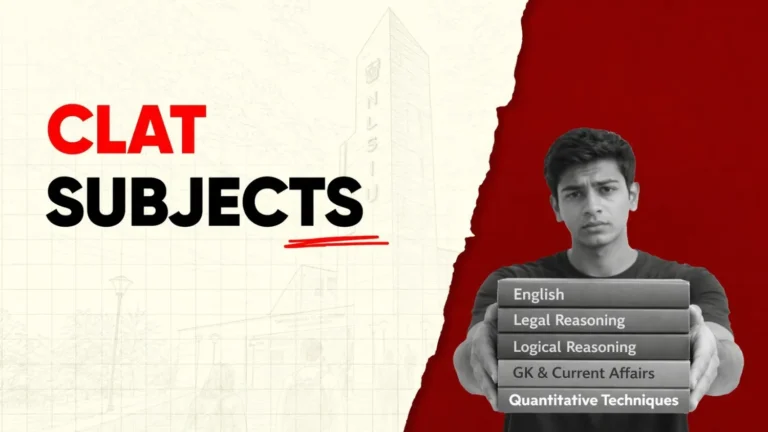
The CLAT UG exam syllabus covers 5 sections: English Language, Current Affairs, Legal Reasoning, Logical Reasoning, and Quantitative Techniques.

SubjectKey Topics / Skills Tested
English LanguageReading comprehension, main idea identification, inference-based questions, summarisation, vocabulary in context, comparison of arguments
Current Affairs & General KnowledgeNational & international current events, arts & culture, international affairs, historical events of significance
Legal ReasoningUnderstanding legal principles, application of rules to facts, analysis of legal scenarios, public policy & moral questions
Logical ReasoningArgument identification, critical reasoning, inference making, analogies, relationships, and evaluating arguments
Quantitative TechniquesData interpretation, numerical analysis, basic mathematics (ratios, algebra, mensuration, statistics)

CLAT PG Syllabus 2027

The postgraduate course syllabus focuses on the subject expertise of aspiring candidates. The CLAT LLM exam syllabus will test the candidate’s proficiency in different laws specified in the table below:

SectionKey Areas Covered
Constitutional LawFundamental rights, duties, judiciary, and constitutional provisions
JurisprudenceLegal theories, concepts, and principles
Administrative LawGovernment powers, administrative actions, tribunals
Law of ContractAgreements, breach, remedies
TortsCivil wrongs, liabilities, negligence
Family LawMarriage, divorce, inheritance
Criminal LawIPC, criminal liability, offences
Property LawOwnership, transfer of property
Company LawCorporate structure, governance
Public International LawInternational treaties, organisations
Tax LawDirect & indirect taxation basics
Environmental LawEnvironmental protection laws
Labour & Industrial LawEmployment laws, worker rights

CLAT Application Process 2027

Here is a step-by-step guide to filling out the CLAT application form easily:

  1. Visit the Official CLAT Portal: Go to the Consortium of National Law Universities’ official website and click on “CLAT 2027”. Then select the “Register” option.
  2. Register & Create Login Credentials: Enter your name, email ID, and mobile number to create an account. Verify the OTP, then log in with your credentials.
  3. Fill Personal & Category Details: Provide your name, date of birth, and category (General/SC/ST/OBC). Upload a passport-size photograph and signature in the prescribed format.
  4. Enter Communication Details: Fill in your correspondence and permanent address, including state, district, PIN code, and contact details.
  5. Fill Qualifying Examination Details: Enter details of your qualifying exam (Class 12 or LLB), including board/university name, passing year, and marks. If applicable, select “Appearing in 2027”.
  6. Choose Test Centre Preferences: Select up to three preferred exam cities. The final allotment will be determined by availability.
  7. Upload Required Documents: Upload necessary certificates such as category, domicile, PwD, or NRI documents (if applicable).
  8. Pay Application Fee: Complete the payment online via debit card, credit card, UPI, or net banking. An additional ₹500 is required for the CLAT previous year’s question papers.
  9. Submit & Save Confirmation: Review all details carefully, submit the form, and download the confirmation page and fee receipt for future use.

CLAT Exam Important Dates 2027

The CLAT 2027 exam date is expected to be 6 December 2026 (Sunday). The registration window is likely to open in August 2026, and the Consortium of NLUs will release the official notification in July 2026.

EventTentative Date
CLAT 2027 Notification Release20 July 2026
CLAT 2027 Application Start Date1 August 2026
Last Date to Apply for CLAT 202731 October 2026
Admit Card Release3rd Week of November 2026
CLAT 2027 Exam Date6 December 2026 (Sunday)
Provisional Answer Key Release8–9 December 2026
Objection Window9–11 December 2026
Final Answer Key Release3rd Week of December 2026
CLAT 2027 Result Date3rd Week of December 2026
Counselling Registration StartsLast Week of December 2026

Courses Offered Through CLAT

The CLAT exam offers admission to a variety of undergraduate and postgraduate law courses at top National Law Universities (NLUs):

Course LevelCourse NameDurationDescription
Undergraduate (UG)BA LLB5 YearsCombines Arts subjects with law studies
BBA LLB5 YearsIntegrates business administration with law
BCom LLB5 YearsFocuses on commerce along with legal education
BSc LLB5 YearsBlends science subjects with law
BSW LLB5 YearsCombines social work with legal studies
Postgraduate (PG)LLM (Master of Laws)1 YearAdvanced specialisation in various fields of law

Participating Colleges and NLUs Accepting CLAT Scores

Several prestigious National Law Universities (NLUs) and participating colleges across India accept CLAT scores for admission to their undergraduate and postgraduate law programs.

Sr. NoName of NLULocation
1National Law School of India University (NLSIU)Bengaluru, Karnataka
2NALSAR University of LawHyderabad, Telangana
3National Law Institute University (NLIU)Bhopal, Madhya Pradesh
4WB National University of Juridical Sciences (WBNUJS)Kolkata, West Bengal
5National Law University, Jodhpur (NLUJ)Jodhpur, Rajasthan
6Gujarat National Law University (GNLU)Gandhinagar, Gujarat
7Hidayatullah National Law University (HNLU)Raipur, Chhattisgarh
8Dr Ram Manohar Lohiya National Law University (RMLNLU)Lucknow, Uttar Pradesh
9National University of Advanced Legal Studies (NUALS)Kochi, Kerala
10Rajiv Gandhi National University of Law (RGNUL)Patiala, Punjab
11Chanakya National Law University (CNLU)Patna, Bihar
12Damodaram Sanjivayya National Law University (DSNLU)Visakhapatnam, Andhra Pradesh
13National Law University Odisha (NLUO)Cuttack, Odisha
14National Law University and Judicial Academy (NLUJA)Guwahati, Assam
15National University of Study and Research in Law (NUSRL)Ranchi, Jharkhand
16Tamil Nadu National Law University (TNNLU)Tiruchirappalli, Tamil Nadu
17Dr B.R. Ambedkar National Law University (DBRANLU)Sonipat, Haryana
18Maharashtra National Law University, Mumbai (MNLU Mumbai)Mumbai, Maharashtra
19Maharashtra National Law University, Nagpur (MNLU Nagpur)Nagpur, Maharashtra
20Himachal Pradesh National Law University (HPNLU)Shimla, Himachal Pradesh
21Maharashtra National Law University, Aurangabad (MNLU Aurangabad)Aurangabad, Maharashtra
22Dharmashastra National Law University (DNLU)Jabalpur, Madhya Pradesh
23National Law University Tripura (NLUT)Agartala, Tripura
24GNLU Silvassa CampusSilvassa, Dadra & Nagar Haveli
25Dr Rajendra Prasad National Law University (RPNLU)Prayagraj, Uttar Pradesh
26India International University of Legal Education & Research (IIULER)Goa
27The National Law University of MeghalayaShillong, Meghalaya

Career Opportunities After CLAT

Qualifying for the CLAT 2027 opens up diverse and rewarding career paths in the legal field.

Career OptionDescription
Litigation LawyerPractice in courts by representing clients in civil or criminal cases after enrolling with the Bar Council
Corporate LawyerWork with companies handling legal compliance, contracts, mergers, and corporate governance
Judicial ServicesBecome a judge by clearing the state judiciary exams after completing your law degree
Legal AdvisorProvide legal guidance to organisations, firms, or individuals
Public Sector Jobs (PSUs)Join PSUs as legal officers through CLAT PG scores
Civil ServicesPrepare for UPSC or state PCS exams for administrative roles
Academia & ResearchPursue LLM/PhD and become a lecturer or legal researcher
Legal JournalismWork in media covering legal news, court cases, and policy developments

Other Opportunities

  • Law firms (litigation & corporate)
  • NGOs and international organizations
  • Legal process outsourcing (LPOs)
  • Policy-making and think tanks

FAQs on CLAT Full Form

What is the CLAT exam?

The CLAT exam is a national-level entrance test conducted for admission to UG and PG law programs at National Law Universities and other top law colleges in India.

What is the full form of CLAT?

The full form of CLAT is Common Law Admission Test, which is a centralised exam for law admissions in India.

Who conducts the CLAT exam?

The exam is conducted by the Consortium of National Law Universities, which manages the entire process, including registration, exam pattern, and result declaration.

What is CLAT exam for?

CLAT is conducted for admission to 5-year integrated LLB and 1-year LLM programs offered by NLUs and other participating law colleges.

How many NLUs accept CLAT scores?

Currently, 27 National Law Universities accept CLAT scores for admission.

What is the eligibility for CLAT 2027?

For UG courses, candidates must have completed 10+2 with at least 45% marks (40% for SC/ST). For PG courses, candidates must hold an LLB degree with the required minimum marks.

What is the exam pattern of CLAT 2027?

The CLAT exam consists of 120 multiple-choice questions, carries 120 marks, and lasts 2 hours. There is a negative marking of 0.25 marks for each incorrect answer.

What subjects are included in the CLAT syllabus?

The CLAT UG syllabus includes English, Current Affairs & GK, Legal Reasoning, Logical Reasoning, and Quantitative Techniques. The PG syllabus includes major law subjects such as Constitutional Law and Jurisprudence.

When will the CLAT 2027 exam be conducted?

The CLAT 2027 exam is expected to be held on 6 December 2026 (Sunday).

How can I fill out the CLAT application form?

You can fill out the CLAT form online by visiting the official website, registering with your details, uploading documents, paying the fee, and submitting the application.

What courses are offered through CLAT?

CLAT offers admission to 5-year integrated law programs, such as BA LLB, BBA LLB, and LLM, as well as postgraduate programs.

What career options are available after CLAT?

After qualifying CLAT, candidates can pursue careers in litigation, corporate law, judiciary, legal advisory, civil services, academia, and more.

Leave a Reply

Your email address will not be published. Required fields are marked *